 ultimate-guide
Cost of EV Charger Installation 2026: Full Guide
Table of Contents
- What Drives EV Charger Installation Costs in 2026
- Level 2 EV Charger Installation Requirements
- Residential Electrical Panel Upgrade Cost in Schenectady
- National Grid EV Charger Rebate in NY: 2026 Update
- How to Get an Accurate EV Charger Installation Quote
- Tips for Reducing Your Total Installation Cost
- Frequently Asked Questions
Last Updated: August 31, 2026
What Drives EV Charger Installation Costs in 2026
The cost of ev charger installation 2026 varies more than most homeowners expect, and the gap between a simple job and a complex one can be significant. At Dragons Electric, we work with Capital District homeowners every week who come in with wildly different quotes from different contractors, and the confusion is understandable. The price you pay depends on a combination of charger type, your home's existing electrical infrastructure, local permit requirements, and site-specific conditions that no online calculator can fully account for.
Here is the core truth: the charger unit itself is often the smallest part of the total cost. The electrical work required to support it is where the real variation happens.
Charger Type: Level 1 vs. Level 2 vs. DC Fast Charger
Level 1 charging uses a standard 120-volt household outlet. No dedicated installation is required beyond a grounded outlet, which most homes already have. The tradeoff is speed: Level 1 typically adds only a few miles of range per hour of charging, making it practical only for drivers with modest daily mileage.
Level 2 charging runs on a 240-volt circuit, the same voltage as a dryer or electric range. This is the standard choice for residential ev charger installation. A Level 2 unit can add substantially more range per hour, and most EV manufacturers recommend it for home use. Installation requires a dedicated circuit, a compatible outlet or hardwired connection, and often a permit.
DC Fast Chargers are commercial-grade equipment. They are rarely installed in single-family homes due to the electrical infrastructure demands they place on a residential service. For most homeowners in Schenectady and the broader Capital District, Level 2 is the right answer.
| Charger Type | Voltage | Typical Use Case | Installation Complexity |
|---|---|---|---|
| Level 1 | 120V | Low daily mileage, existing outlet | Minimal |
| Level 2 | 240V | Daily home charging, most EVs | Moderate to high |
| DC Fast Charger | 480V+ | Commercial/fleet use | Very high |
Site-Specific Factors That Move the Price
The biggest variable in any ev charger installation quote is the distance between your electrical panel and the installation location. A garage adjacent to your panel is a very different job than a detached garage or a driveway installation 60 feet away. Trenching for underground conduit, running wire through finished walls, and working around existing structures all add labor and materials cost.
Other factors that directly affect price:
- Panel capacity: If your panel is already near capacity, adding a 50-amp circuit for a Level 2 charger may require either a panel upgrade or a load management device.
- Panel age and condition: Older panels, common in homes built before the 1970s, may not safely support the additional load without upgrades.
- Conduit requirements: Local codes in New York often require conduit in garages and exterior runs, adding material and labor cost.
- Outlet vs. hardwired: Some charger models are hardwired directly; others use a NEMA 14-50 outlet. Each approach has different installation requirements.
Level 2 EV Charger Installation Requirements
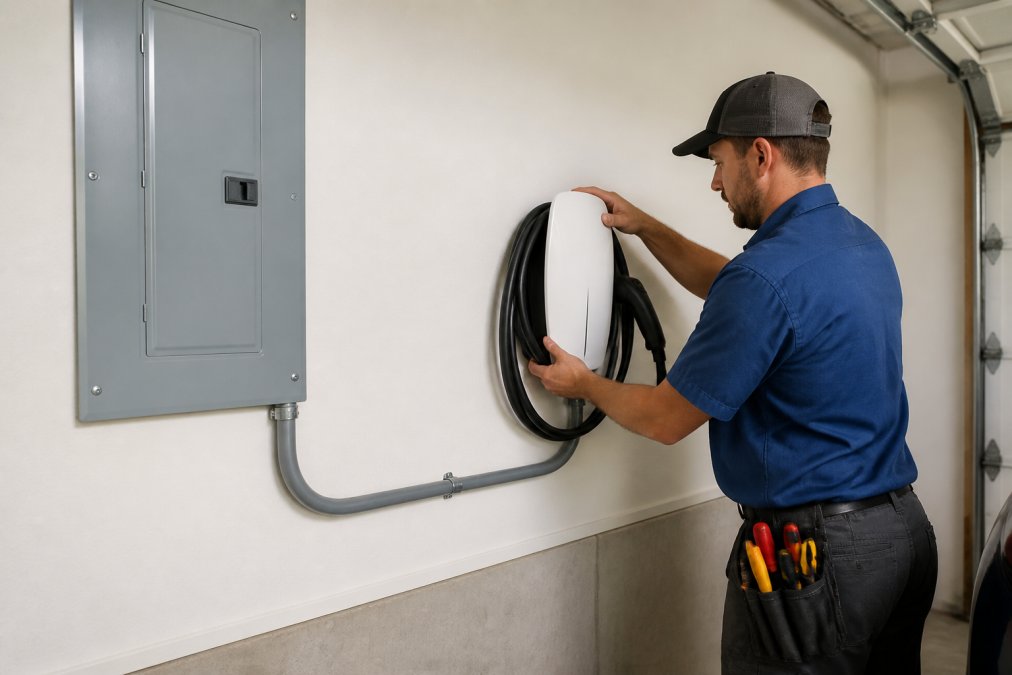
A Level 2 EV charger installation requires a dedicated 240-volt circuit, typically rated at 50 amps to support most residential charger units. "Dedicated" means that circuit serves only the charger, with no other devices sharing it.
Dedicated Circuit and Amperage Minimums
Most Level 2 chargers draw between 32 and 48 amps continuously. The National Electrical Code requirements for EV charging circuits specifies that a circuit must be rated at 125% of the continuous load, which is why a 40-amp charger typically requires a 50-amp circuit. Your electrician will size the wire gauge, breaker, and conduit to match both the charger's requirements and local code.
A common mistake is assuming the existing wiring in your garage can handle the load. Garages in older homes often have undersized wiring or shared circuits that cannot safely support a Level 2 charger without modification. Getting this wrong creates a fire risk, not just a tripped breaker.
Permit and Inspection Requirements
In New York, ev charger installation work on a dedicated 240-volt circuit requires an electrical permit in most municipalities, including Schenectady. The permit process involves submitting a work description to the local building department, having a licensed electrician perform the installation, and scheduling an inspection before the circuit is energized.
Skipping the permit is a real risk. Unpermitted electrical work can complicate homeowners insurance claims, create issues when selling your home, and in some cases void the warranty on the charger itself. According to New York State Department of State guidance on electrical permits, work performed without required permits may need to be removed and redone at the homeowner's expense.
The inspection process is straightforward when the work is done correctly. A licensed electrician familiar with local requirements will handle the permit application as part of the job.
Residential Electrical Panel Upgrade Cost in Schenectady
Many Schenectady homes, particularly those built in the mid-20th century, are running on 100-amp or even 60-amp electrical service. Adding a Level 2 EV charger to a panel that is already managing air conditioning, electric appliances, and modern electronics can push that service to its limit.
A residential electrical panel upgrade is the process of replacing an outdated or undersized panel with a modern 200-amp (or larger) service. This is not just about adding capacity for your EV charger. It is also an opportunity to address aging equipment, improve safety, and future-proof your home for additional loads like a heat pump or backup generator.
The cost of a panel upgrade in Schenectady depends on the scope of work: the size of the new panel, whether the utility service entrance needs to be upgraded, and whether any rewiring is required to bring existing circuits up to current code. Panel upgrades require coordination with National Grid, the local utility, to upgrade or reconnect the service entrance. That process adds scheduling time, so plan accordingly.
What most guides miss: combining your panel upgrade with your EV charger installation is almost always more cost-effective than doing them as separate projects. The electrician is already on site, the permit covers both, and the inspection happens once. Homeowners who try to sequence these jobs separately often pay more in total.
National Grid EV Charger Rebate in NY: 2026 Update
Incentives for EV charger installation have continued to evolve in 2026, and homeowners in Schenectady should understand what is currently available before committing to a project budget.
National Grid EV charger rebate NY programs have offered residential customers rebates for qualifying Level 2 charger equipment and, in some cases, installation costs. Program terms, eligibility requirements, and rebate amounts change regularly. The most accurate current information is available directly through National Grid's electric vehicle charging programs for New York customers. Check that page before purchasing equipment, as rebate eligibility often depends on the specific charger model and installation timing.
Federal Tax Credit: 30C Alternative Fuel Vehicle Refueling Property Credit
The federal 30C tax credit covers a portion of the cost of qualified EV charging equipment and installation for residential properties. As of 2026, this credit applies to ev charger installation at a primary residence, subject to income and equipment eligibility requirements.
The credit is claimed on your federal income tax return. Because tax rules change and individual eligibility varies, consult a tax professional or review the current guidance from the IRS Alternative Fuel Vehicle Refueling Property Credit guidance before assuming you qualify. The credit can meaningfully reduce your net out-of-pocket cost, but only if you claim it correctly.
The practical takeaway: between the National Grid rebate and the federal 30C credit, many homeowners in the Capital District can offset a meaningful portion of their total ev charger installation cost. Do the homework before you install, not after.
How to Get an Accurate EV Charger Installation Quote
Getting three quotes is standard advice, but it only works if you know what each quote actually includes. A quote for ev charger installation should be itemized enough to compare apples to apples.
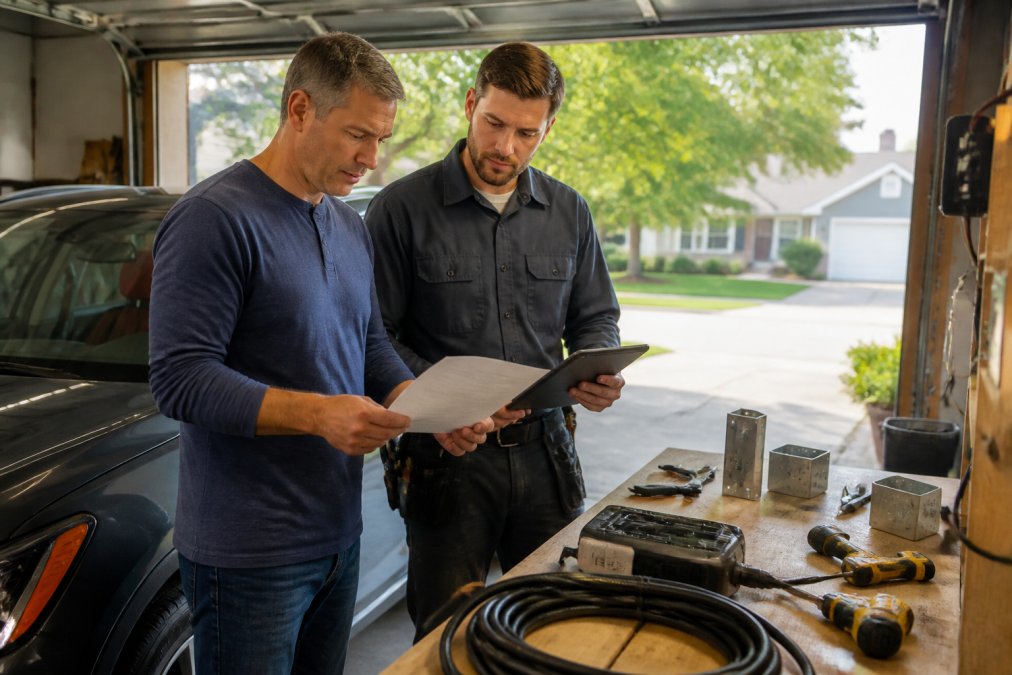
Here is what a complete quote should specify:
- The charger model and specifications being installed
- Circuit size and wire gauge
- Whether the quote includes permit fees
- Conduit type and routing path
- Whether a panel assessment is included or billed separately
- Any contingency language around panel upgrades if needed
At Dragons Electric, we provide a full consultation to walk through your specific home's setup, explain your options, and give you a clear scope before any work begins. That means no surprises once the job starts.
Red Flags in Low-Ball Quotes
The question we hear often from homeowners: "One contractor quoted me significantly less than everyone else. Should I go with them?"
Sometimes a low quote reflects efficiency. More often, it reflects something missing from the scope. Watch for these patterns:
- No permit included: Pulling a permit costs money and time. A quote that excludes it is not cheaper; it is incomplete.
- No site assessment: A contractor who quotes a flat price without seeing your panel and garage is guessing at the scope.
- Vague language: "Circuit installation" without specifying wire gauge, breaker size, or conduit type leaves room for cost additions later.
- No mention of inspection: In New York, the inspection is required. If it is not in the quote, ask why.
The real cost of a bad install is not just the rework. It is the permit violation, the insurance issue, and the safety risk. Price is one factor. Scope and accountability are the others.
Tips for Reducing Your Total Installation Cost
Smart planning reduces ev charger installation costs without cutting corners on safety or code compliance. These are the approaches that actually work.
Combine projects. If your home needs a panel upgrade anyway, do it at the same time as the EV charger installation. One mobilization, one permit, one inspection.
Choose the right charger for your actual needs. A 48-amp hardwired unit is not necessary for every driver. If your daily mileage is modest, a 32-amp unit on a 40-amp circuit is sufficient and less expensive to install.
Locate the charger close to your panel. Every additional foot of conduit run adds cost. If your garage is adjacent to your panel, that is your best installation location. If you have flexibility on where the charger goes, use it.
Apply for incentives before you buy the equipment. Some National Grid rebate programs require pre-approval or specific equipment models. Buying the charger first and applying after can result in disqualification.
Get your permit pulled correctly the first time. Failed inspections require re-inspection fees and, sometimes, rework. A licensed electrician who knows Schenectady's local requirements will get it right on the first pass.
Use a load management device if your panel is near capacity. These devices monitor your home's total electrical load and reduce the charger's output when other high-draw appliances are running. They can eliminate the need for a full panel upgrade in some cases, at a fraction of the cost.
| Cost Reduction Strategy | When It Applies | Potential Impact |
|---|---|---|
| Combine with panel upgrade | Panel already needs work | Saves on mobilization and permit costs |
| Right-size the charger | Moderate daily mileage | Lower circuit and material costs |
| Minimize conduit run | Flexible on charger location | Reduces labor and materials |
| Apply for incentives first | Before purchasing equipment | Offsets equipment and installation cost |
| Load management device | Panel near capacity | May avoid full panel upgrade |
Planning an EV charger installation involves more moving parts than most homeowners anticipate, from panel capacity and permit requirements to utility rebates and federal tax credits. Dragons Electric works with homeowners across Schenectady, Albany, and Troy to assess their home's specific electrical setup, explain their options clearly, and complete the installation correctly the first time. Our team specializes in residential electrical services including panel upgrades and EV charger installation, and we stand behind every project. Schedule your installation consultation with Dragons Electric and get a clear, itemized quote before any work begins.
Frequently Asked Questions
How much does it cost to install a Level 2 EV charger in Schenectady?
There is no single fixed price for Level 2 EV charger installation in Schenectady. The total depends on your home's existing electrical capacity, the distance from your panel to the garage, whether a permit is required, and if a panel upgrade is needed. Quotes in the region vary significantly from job to job. Contact a licensed local electrician for an on-site assessment so you receive a price based on your actual conditions, not a generic estimate.
Does National Grid offer incentives for home EV charger installation in New York?
National Grid has offered EV charger rebate programs for residential customers in New York, and similar programs are expected to continue through 2026. Program availability and rebate amounts change periodically, so check National Grid's current residential programs page or ask your electrician before scheduling installation. Stacking a National Grid rebate with the federal 30C tax credit can meaningfully reduce your out-of-pocket cost for ev charger installation.
Does my Schenectady home need an electrical panel upgrade for an EV charger?
Many older homes in Schenectady, particularly those built before the 1980s, run 100-amp or smaller panels that lack the spare capacity a Level 2 charger requires. A licensed electrician will assess your current panel load during the quote visit. If an upgrade is needed, it adds to the project cost but also improves overall home electrical safety. Homes with 200-amp panels in good condition often avoid this extra expense entirely.
What is the difference between Level 1 and Level 2 charging costs?
Level 1 charging uses a standard 120V household outlet and typically requires no new wiring, making it the lowest-cost option upfront. The trade-off is slow charging speed, adding only a few miles of range per hour. Level 2 charging runs on a 240V dedicated circuit and charges several times faster, but requires professional EV charger installation of a dedicated circuit and potentially a panel upgrade. Most homeowners find Level 2 worth the higher installation investment.
How long does it take to install a home EV charger?
A straightforward Level 2 EV charger installation in a home with adequate panel capacity typically takes a licensed electrician three to six hours in a single visit. Jobs that require trenching conduit to a detached garage, pulling a permit, or upgrading the electrical panel will take longer and may span more than one day. Your electrician should give you a realistic timeline during the initial consultation before any work begins.
Are there federal tax credits for EV charger installation in 2026?
Yes. The federal 30C Alternative Fuel Vehicle Refueling Property Credit covers a percentage of qualified EV charger installation costs for residential property owners. The credit applies to both the equipment and the installation labor. Income limits and credit caps apply, and the property must be in an eligible census tract under current IRS guidance. Consult a tax professional to confirm your specific eligibility before filing, as program terms can change between tax years.
This article was written using GrandRanker
Frequently Asked Questions
How much does it cost to install a Level 2 EV charger in Schenectady?
There is no single fixed price for Level 2 EV charger installation in Schenectady. The total depends on your home's existing electrical capacity, the distance from your panel to the garage, whether a permit is required, and if a panel upgrade is needed. Quotes in the region vary significantly from job to job. Contact a licensed local electrician for an on-site assessment so you receive a price based on your actual conditions, not a generic estimate.
Does National Grid offer incentives for home EV charger installation in New York?
National Grid has offered EV charger rebate programs for residential customers in New York, and similar programs are expected to continue through 2026. Program availability and rebate amounts change periodically, so check National Grid's current residential programs page or ask your electrician before scheduling installation. Stacking a National Grid rebate with the federal 30C tax credit can meaningfully reduce your out-of-pocket cost for ev charger installation.
Does my Schenectady home need an electrical panel upgrade for an EV charger?
Many older homes in Schenectady, particularly those built before the 1980s, run 100-amp or smaller panels that lack the spare capacity a Level 2 charger requires. A licensed electrician will assess your current panel load during the quote visit. If an upgrade is needed, it adds to the project cost but also improves overall home electrical safety. Homes with 200-amp panels in good condition often avoid this extra expense entirely.
What is the difference between Level 1 and Level 2 charging costs?
Level 1 charging uses a standard 120V household outlet and typically requires no new wiring, making it the lowest-cost option upfront. The trade-off is slow charging speed, adding only a few miles of range per hour. Level 2 charging runs on a 240V dedicated circuit and charges several times faster, but requires professional EV charger installation of a dedicated circuit and potentially a panel upgrade. Most homeowners find Level 2 worth the higher installation investment.
How long does it take to install a home EV charger?
A straightforward Level 2 EV charger installation in a home with adequate panel capacity typically takes a licensed electrician three to six hours in a single visit. Jobs that require trenching conduit to a detached garage, pulling a permit, or upgrading the electrical panel will take longer and may span more than one day. Your electrician should give you a realistic timeline during the initial consultation before any work begins.
Are there federal tax credits for EV charger installation in 2026?
Yes. The federal 30C Alternative Fuel Vehicle Refueling Property Credit covers a percentage of qualified EV charger installation costs for residential property owners. The credit applies to both the equipment and the installation labor. Income limits and credit caps apply, and the property must be in an eligible census tract under current IRS guidance. Consult a tax professional to confirm your specific eligibility before filing, as program terms can change between tax years.